In partnership with the Louisiana Department of Health Office of Behavioral Health (OBH), the Center for E2P is supporting the development and training of a network of crisis providers operating within a multi-tiered system of crisis services. The focus of all levels of crisis care is to be person- and family-centered, recovery-oriented, strengths-based and resolution-focused with less reliance of law enforcement, hospitalization, and emergency departments as much as the safety of the situation allows.
Through the Mental Health Crisis Response (MHCR) Workforce Training and Development Program, the Center for E2P is tasked with collaborating with communities throughout Louisiana, identifying a potential workforce, developing and implementing a training curriculum for crisis responders, providing technical assistance, facilitating coaching to ensure appropriate execution of services, and monitoring quality on a continuous basis.
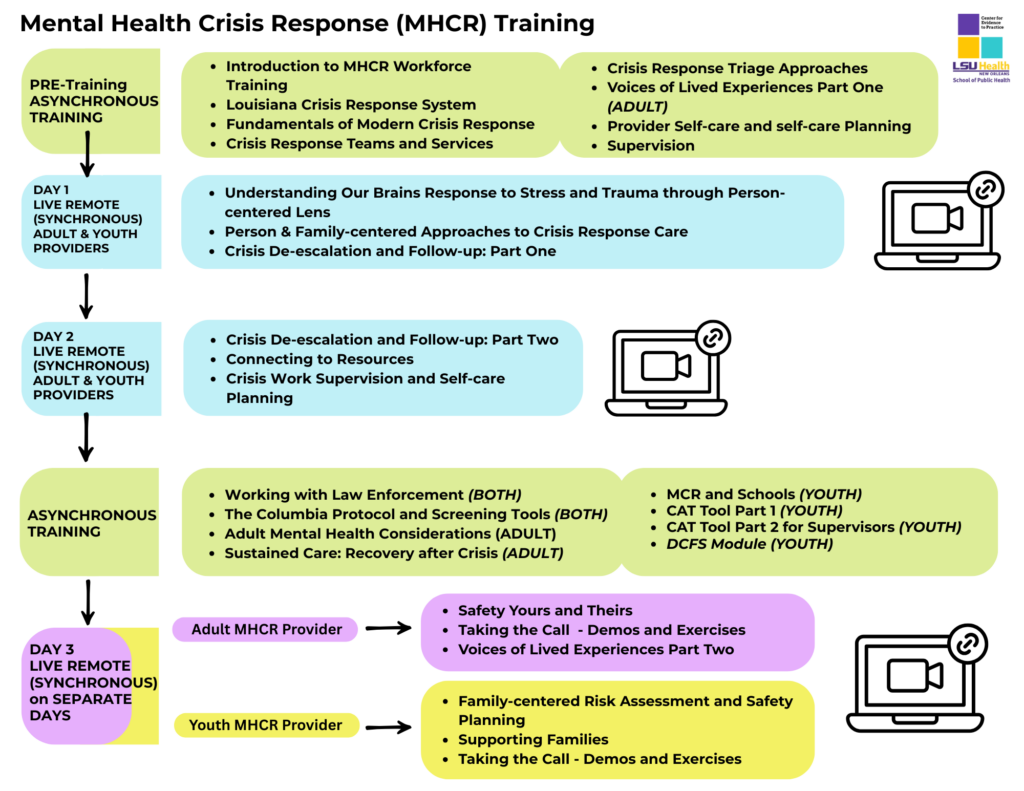
As a participant, you will take this training with a youth-services or adult-services curriculum. Your agency may also send you through both pathways. Click through the above tabs and refer to the below information to learn of your specific requirements.
This is a training to equip the selected behavioral health workforce to implement the Louisiana Crisis Response System (LA-CRS).
Please find resources below to help you throughout the training. Once you’ve initiated training, you have FOUR months to complete your training, otherwise you will need to restart entirely. Although you have 4 months to complete your training, you are advised to begin and complete training as soon as possible.
The training is composed of asynchronous (on your own) and synchronous (on Zoom) components. Please familiarize yourself with the following documents:
- E2P Learn Platform Manual
- Learn how to navigate the features of MHCR training on E2P Learn.
- Training Guidelines
- In order to receive a certificate you must adhere to these guidelines.
- Training Implementation Matrix
- Reference this matrix according to your role with your agency to see your specific role requirements.
- This determines which modules you need to do in order to be ‘complete’ according to your role.
- It is listed as your minimum requirements, but more can be attended or completed per professional preference.
- Training Agenda
- This document outlines the format, delivery and components of training.
- The training modules are categorized according to either joint requirements, or youth-adult specific requirements.
If you are in need of training accommodations for accessibility, please contact us. Thank you for your efforts and participation!
 Have questions outside of Office Hours?
Email us at [email protected] or call (504) 568-5949 with your questions & we’ll reply within regular business hours.
If you are in need of training accommodations for accessibility, please contact us.
If you don’t receive an activation link for my account, email [email protected]
“Which modules are expected of me?”
The agenda breaks down which modules are required for each training, adult or youth. If your agency supervisor expects you to be cross-trained, you will do all E2P Learn modules and attend Day 1 & 2 for all providers, and Day 3 Adult and Day 3 Youth on Zoom. E2P Learn is set-up to only display the courses in which you are enrolled and should complete.
“I watched the video in YouTube and it doesn’t say complete.”
Please watch the video in the system and make sure you click the ‘Mark Complete’ button if available. If you do not, it will not register as having been complete.
“The trainings I attended on Zoom during the live days are not marked complete. Why?”
You have to go into E2P:Learn to 1) view the materials under each module & 2) Mark Complete. The system does not automatically do this and it is set up this way to ensure you are logging in.
“Can I take the modules out of order?”
No.
“I did what I have to do & it doesn’t say it’s complete.”
Please be patient with the system. There’s sometimes a lag in time before you see it marked as complete. Log out and log back in. If you continue to have issues, email [email protected]. Do not use Internet Explorer or MicroSoft Edge to access E2PLearn.
“I took the quiz multiple times and it won’t let me move forward.”
There is a limit to how many times you may attempt a quiz, and you must have a passing rate of 80% or higher to move to the next module. If you have attempted the quiz 6 times and not passed, please email [email protected].
“I clicked on the video and it is not loading.”
Please contact your IT department and make sure that our website as well as YouTube are not blocked at your agency.
“I finished all the modules but I don’t have a certificate of completion.”
Certificates are made in one batch at the end of the month, and are not automatic. If you have attended all training days in full and completed all your required E2P Learn modules, you will receive the certificate in your inbox of the email you registered with.